
Tax Influence Across Different Startup Stages

The taxes directly influence the financial results of a company.
First of all, the tax burden affects free cash flow. The lower the taxes, the higher the free cash flow — which means the company has more opportunities to invest in product development, talent acquisition, and expansion into new markets.
For investors, lower taxes help a company grow faster and achieve its goals. From a financial point of view, this means lower taxation on capital appreciation and a more attractive return. In simple terms, taxation is one of the key factors investors consider when deciding whether to invest.
Startup ecosystems and countries constantly compete to attract startups and create a favorable environment for their development. Our analysis shows that in recent years, major players have intensified the competition to attract scale-ups and unicorns.
A common viewpoint is that a limited tax burden and strong tax incentives are the most critical factors in the early stages of a startup. However, our analysis shows that the impact of taxes increases even more in the later stages of a startup’s growth and development. Moreover, at these later stages, tax conditions can become a major factor in a startup’s decision to relocate to another country or ecosystem.
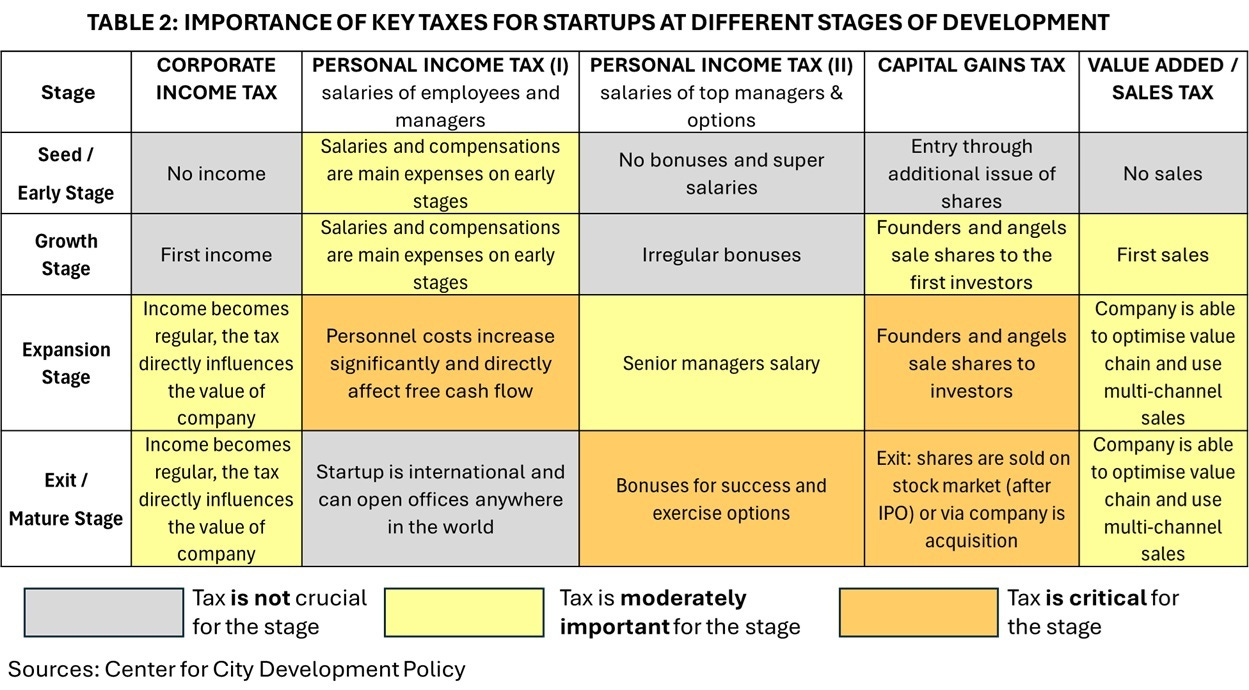
Seed & Early Stage – The startup is newly established and developing its first product. Annual revenue is $5 million or less, and valuation is under $50 million. Since there is little or no income, there is no corporate tax. The main expenses are staff salaries and compensation, so personal income tax (PIT) is the main burden.
Growth Stage – The company begins generating regular income, and revenue may reach $50 million. At this point, corporate income tax (CIT), VAT, and sales tax become relevant. The team expands significantly, so PIT also becomes important.
Expansion Stage – The company enters foreign markets and prepares for an exit. Revenue may reach $500 million. Corporate tax directly affects company value. At this stage, top management salaries and bonuses increase, reaching the highest personal income tax brackets. This is also when capital gains tax (CGT) first becomes relevant, as founders and early investors begin selling some of their shares.
Exit Stage – The company prepares for an IPO (Initial Public Offering) or acquisition. At this stage, capital gains tax is the most critical factor for founders and investors.
In summary: Where you build your company is as important as what you are building.
For founders – tax planning is not optional; it must be part of the growth strategy. It influences both the pace of growth and investor interest.
For investors – the tax environment directly impacts potential returns and the risk-to-reward ratio.
The link to the full report is available in the first comment.
Your comments are welcome!
The report: https://www.cdp.center/post/tax-environment-review-best-practices-of-leading-startup-ecosystems-for-ict-ai-startup-growth-part-1